- Maharashtra Legislative Assembly to get Deputy Speaker after the longest interval of four years. The elections will be held on November 30.
- Mr. Hardeep Singh Puri, Minister of State (I / C) Housing and Urban Affairs will review the progress of urban mission in eight states of North-Eastern region on December 1, 2018.
- Indian Railways announced that it will transport relief material free of cost to the cyclone affected districts of Tamil Nadu by December 10.
- Countdown began for the launch of PSLV-C43, the national space agency ISRO's Polar Satellite Launch Vehicle.
- With the aim of creating a profile of India's startup sector, the Reserve Bank has started a survey to measure its scope of business, profitability and workforce.
- In the ICC Women's T20 International Player Rankings, Indian captain Harmanpreet Kaur entered the top five and reached number three position.
- To participate in the 13th G-20 Summit, Prime Minister Narendra Modi will leave for Argentina's capital, Buenos Aires.
- 2018 Topics - Building Consensus for a Fair and Sustainable Development
- Shri Nitin Gadkari, Minister of Shipping, Road Transport and Highways, Water Resources, River Development and Ganga Conservation, was addressed in the continuous Blue Economy Conference in Nairobi.
- The Saudi-India trade meeting was organized with the Saudi Chamber's Council during the visit of the Indian Saudi and Housing delegation to Saudi Arabia.
- Dr. Anand Gupta is organizing the second bi-annual National Conference of Smriti Lectures and Heads of Investigation Agencies in Police Research and Development Bureau (BPR & D) New Delhi.
- Sunil Arora - Chief Election Commissioner
- M. Nike - President of National Skill Development Corporation
- A five-day exhibition was inaugurated on "Our vote-our future" organized by the Regional Outreach Bureau of Information and Broadcasting Ministry, Telangana, Hyderabad.
- Asian Development Bank ADB will provide a loan of 75 million dollars for the water supply project in four coastal towns of Karnataka.
- Ministry of Housing and Urban Affairs has approved the construction of more than two lakh affordable houses for the benefit of the urban poor under the Prime Minister's Accommodation Scheme (Urban).
- The title of the Chess World Championship will be decided by fast tiebreaker games in London, which will be decided between Norway's world champion Magnus Carlsen and the American challenger Fabiano Caruana.
- The Board of Control for Cricket in India (BCCI) has doubled the restriction for age fraud.
- Men's Hockey World Cup, India will fight with South Africa in Bhubaneswar
Examntra.com started as an online learning portal for the help of aspiring candidates of various exams. It is a venture owned by Examantra Learning Portal. which will incorporate all the latest news, vacancies, results, eligibility criteria for different exams, etc. We cater to the learning needs of candidates of Bank Exams, SSC, Bank, IIT NEET across the country.
Wednesday, November 28, 2018
Current Affairs Nov 28, 2018
Tuesday, November 27, 2018
Current Affairs November 27, 2018
- In Arunachal Pradesh, the first Arunachal literature festival will be held from November 28 to November 30 at the Dorjee Khandu Convention Center of Itanagar.
- Bihar Chief Minister Nitish Kumar unveiled a 70-feet tall statue of Lord Buddha in Rajgir of Nalanda district.
- India's premier National Research Laboratory, Scientific and Industrial Research Council - Micro-Institute of Technology (CSIR-Imtech) announced that it will set up a high skill development center in Chandigarh with Merck, a leading science and technology company in Germany.
- Nagaland Chief Minister Nifu Rio introduced state tourism police in police headquarters in Kohima. To present the tourist police, Nagaland became the second state in the North East.
- Union Minister of Commerce & Industry and Civil Aviation, Shri Suresh Prabhu has issued a brochure along with the logo (logos) of Logics India 2019 in New Delhi.
- The Nepal Government has launched a social security scheme for the workers of the formal sector of the country.
- British Prime Minister Theresa May announced that the last vote on the Treaty of the European Union (EU) will be on December 11.
- Romania strongly supports India's proposal to the United Nations for a comprehensive conference on International Terrorism (CCIT).
- National Project Construction Corporation Limited (NPCC) has been awarded category of category: Category-1 of the Miniratna by the Government of India.
- The United Nations has chosen Noida and Greater Noida in Uttar Pradesh to participate in its Global Sustainable Cities 2025 initiative.
- A five-day exhibition was inaugurated on "Our vote-our future" organized by the Regional Outreach Bureau of Information and Broadcasting Ministry, Telangana, Hyderabad.
- Government of India and Asian Development Bank (ADB) sign $ 75 million loan to improve urban services in 4 Karnataka cities.
- Harmanpreet Kaur named the captain of ICC Women's World Twenty20 XI, including openers Smriti Mandana and leg-spinner Poonam Yadav.
Monday, November 26, 2018
Current Affairs Nov 26
Sunday, November 25, 2018
Current Affairs Nov 25
- 2018 Theme - "Orange the World: # HigherMatu"
- The President of India, Shri Ram Nath Kovind inaugurated the Constitution Day celebrations organized by the Supreme Court on November 26, 1949 (November 26, 2018) to celebrate the anniversary of adopting our Constitution in New Delhi.
- Union Minister of State for Home, Kiren Rijju, will inaugurate the 14th Formation Day of National Disaster Management Authority (NDMA). 2018 Theme - "Initial Warnings for Disasters"
- National Ritual for Children of Child Care Institutions (CCI) - Secretary, New Delhi, Shri Rakesh Srivastava inaugurated the "Hausla 2018" of the Ministry of Women and Child Development (MWCD). 2018 topics - "Child safety".
- To keep the tribal languages disappear in circulation, the Odisha government came out with lectures such as 21 such languages.
- Vice President Venkaiah Naidu laid the foundation stone for the construction of the foundation stone of Darbar Sahib for construction of a visa-free corridor from the Indian side in Kartarpur on 26 November.
- 27 leaders of other EU members approved the conditions for a historic breakfix deal with Britain at a special summit in Brussels on Sunday.
- On the 10th anniversary of the Mumbai terror attacks, the award for the State Department's award (RFJ) program for the year 2008 was $ 5 million for information due to the arrest or conviction of any person involved in making or facilitating the facility. New Rewards Mumbai Attack
Tuesday, November 20, 2018
NASA has announced end of its historic DAWN mission.
Context
NASA has announced end of its historic DAWN mission.
About
- Dawn was a space probe launched by NASA in September 2007 to study two of the three known proto planets of the asteroid belt, Vesta and Ceres.
- It was the first and only mission to visit both Vesta and Ceres.
- It was also NASA's first deep space mission to use ion propulsion.
- It used three xenon-fueled ion engines for its main source of propulsion beside its maneuvering thrusters which depend on hydrazine.
- DAWN mission was extended 11 years more than its expected life span.PROTO-PLANET:Proto-planets are small celestial objects that are the size of a moon or a bit bigger. They are small planets, like an even smaller version of a dwarf planet. Astronomers believe that these objects form during the creation of a solar system.CRYOVOLCANO:A Cryovolcano (as known as ice volcano) is a type of volcano that erupts volatiles such as water, ammonia or methane, instead of molten rock.
Significance
- Dawn mission gave deep insight on understanding about protoplanets of Asteroid belt. It revealed the irregular relief of Vesta in dramatic detail, mapping it from pole to pole while probing it from core to surface.
- It also gave key insights into the cryovolcanic activity erupting on the surface of Ceres and a look at an active dwarf planet. Between Ceres and Vesta, Dawn explored about 45% (nearly half) of the mass of the main asteroid belt.
Thursday, October 11, 2018
IPCC REPORT 2018
Context
- The Intergovernmental Panel on Climate Change (IPCC) has released a special report on the actions the world needs to take to prevent global average temperatures from rising beyond 1.5°C as compared to pre-industrial times.
- The ‘Special Report on Global Warming of 1.5°C,’ compares the impact of global warming of 1.5 degree C and 2 degree C. It provides details on how the global response to climate change needs to be strengthened within the broader context of sustainable development and continuing efforts to eradicate poverty.
- The reportwill be a key scientific input for the Climate Change Conference in Poland in December 2018, when governments review the Paris Agreement to tackle climate change.
Background
- It was in 2015, at the Paris climate conference, that the global community made a pact to pursue efforts to limit warming to within 1.5°C — half a degree below the previous target of 2°C. With the increase in extreme events and the very survival of small islands at stake, the lower limit was greeted then with surprise and enthusiasm.
IPCC
- It is the international body for assessing the science related to climate change.
- It was set up in 1988 by the World Meteorological Organization (WMO) and United Nations Environment Programme (UNEP) to provide policymakers with regular assessments of the scientific basis of climate change, its impacts and future risks, and options for adaptation and mitigation.
- It assessments provide a scientific basis for governments at all levels to develop climate related policies, and they underlie negotiations at the UN Climate Conference – the United Nations Framework Convention on Climate Change (UNFCCC).
About:
Key Highlights of the Report
- At current rate of emissions, the world is set to breach the global warming limit of 1.5 degrees Celsius between 2030 and 2052. At present, the world is 1.2°C warmer compared to pre-industrial levels.
- Climate change could have “irreversible” and “catastrophic” impacts if the global average temperatures were allowed to rise beyond 2 degrees Celsius. Climate-related risks for natural and human systems are higher.
- There could be progressive worsening of extreme weather events as temperature rises.
- The report gave a more comprehensive assessment of the differences in a 1.5C world and 2C world and quantified the carbon dioxide that would need to be removed from the atmosphere to achieve this.
- The international effort to tackle climate change must be accelerated in order to limit global temperature rises.
- The report notes that investment in physical and social infrastructure is a key enabler in enhancing resilience and adaptive capacity.
- Poorly designed or implemented adaptation projects can increase greenhouse gas emissions and water use, increase gender and social inequality, undermine health conditions, and encroach on natural ecosystems.
- Hence, adaptation efforts must pay attention to poverty and sustainable development and these efforts need financial support.
- Adaptation needs have generally been supported by public sector sources, multilateral development banks, NGOs, private funding and UNFCCC channels.
- According to the report, there is a need to integrate Disaster risk management (DRM) and adaptation to reduce vulnerability. The report also identifies “educational adaptation” options which motivate adaptation through building awareness.
- A more participatory approach towards adaptation, especially for vulnerable population will be to formulate adaptation action based on indigenous knowledge. These people are threatened by cultural modification, dispossession of land rights and land grabbing, rapid environmental and social changes. Therefore recognition of indigenous rights, governance systems and laws is central to adaptation, mitigation and sustainable development.
- Involvement of local governments is important too since they enable more participative decision-making and involve wider community in designing and implementing adaptation policies.
What is 1.5-degree C target?
- Since 1990s, countries started discussing climate change and began negotiating an international arrangement for tackling it together.The objective has been to limit rising global average temperatures to within 2°C from pre-industrial times
- Periodic Assessment Reports produced by IPCC, suggest that the impacts of climate change could be “irreversible” and “catastrophic” if the rise in temperature was allowed to go beyond the 2°C ceiling.
- Small island states and the least developed nations are likely to suffer the worst consequences of climate change. These countries negotiated that the goal should be to restrict the temperature rise within 1.5°C from pre-industrial times.
- A 1.5°C target demanded much deeper emission cuts from the big emitters, which in turn required massive deployment of financial and technological resources.
- The Paris Agreement ‘hold’ the increase in global average temperature to “well below” 2°C. It also promised to keep “pursuing efforts” to attain the 1.5°C target.
- Incidentally, the global average temperature has already risen by more than 1°C from pre-industrial times.At the current rate, the 1.5°C limit could be crossed as early as 2040.
How to attain the 1.5 degree target?
- The IPCC report suggests possible pathways to attain the 1.5°C objective.
- It would involve much sharper and quicker emission cuts by big emitters like China, the US, the European Union and India.
- These pathways are likely to be heavily dependent on the success of carbon removal technologies. However, no such technology exists yet but several possibilities are being explored.Carbon Dioxide Removal (CDR)
- IPCC has presented four pathways through which the 1.5 degree target can be achieved.Each of these pathways is also dependent on some amount of Carbon Dioxide Removal (CDR).
- CDR is the physical removal of the stock of carbon dioxide from the atmosphere to reduce its concentrations. Technologies for CDR are still undeveloped and untested.
- According to the report, varying amounts between 100 to 1000 Gigatons of carbon dioxide would need to be removed from the atmosphere.
Why settling for 1.5 degree target?- Research found that limiting global warming to 1.5°C could prevent around 3.3 million cases of dengue every year in Latin America and the Caribbean alone.
- According to World Bank report, additional 150 million people could be at risk from malaria if the temperature was allowed to increase beyond 2°C.
- The world could have 25 million fewer undernourished people by the end of the century, if the 1.5°C goal was achieved.
- 350 million additional people could be exposed to deadly heat waves if the warming increased to 2°C as compared to 1.5°C.
- A 1.5°C could prevent 153 million premature deaths due to air pollution by 2100, as compared to the 2°C scenario.
- A UNDP report in 2016 claimed that a 1.5°C strategy could create double the number of jobs in the energy sector by 2050. The world could be 3% wealthier by 2100 in a 1.5°C scenario compared to a 2°C scenario.
- Extreme weather events such as heavy rainfall and heat waves are likely to become more severe and frequent, and freshwater supply could fall sharply, in a 2°C world.
Impact on India- According to the report, coastal nations and agricultural economies like India would be the worst affected.
- Decline in crop yields, unprecedented climate extremes and increased susceptibility could push poverty by several million by 2050.
- SunitaNarain, Director General, CSE in response to the report has remarked - “Even at a little over 1.0°C warming, India is being battered by the worst climate extremes – it is clear that the situation at 1.5°C is going to worsen. The new report from the IPCC has served us a final warning that we must get our act together — now and quickly,”
- India hadn’t made any scientific contribution — in terms of modelling possible climate change-impact to its agriculture, monsoon, urban dwellings — to this report but gave critical inputs to the scientific basis underlying these assessments.
Recommendations- To limit ourselves to 1.5°C, global net anthropogenic CO2 emissions should reduce by about 45 per cent from 2010 levels by 2030, and should reach net-zero around 2050. Along with it, we also need serious cuts to non-CO2 emissions.
- Both methane and black carbon need to be reduced by 35 per cent or more of 2010 levels by 2050.
- Achieving these cuts requires rapid and “far-reaching transitions in energy, land, urban and infrastructure (including transport and buildings), and industrial systems”.It will also require political action and significant scale-up of investment.
- Average annual investment in low-carbon energy technologies and energy efficiency needs to scale up.
- Use of coal should reduce steeply and its share in electricity mix should be reduced to close to 0 per cent by 2050. There is a need for a significant fall in the share of oil in energy production by 2050.
- The industry sector will have to reduce emissions by around 75–90 per cent of 2010 levels by 2050.
- Real emission reductions can be achieved through a combination of new and existing technologies, including sustainable bio-based feedstocks, product substitution, and carbon capture, utilisation and storage (CCUS).
- In the land-use sector, some amount of pasture and non-pasture agricultural land for food and feed crops needs to be converted for energy crops.
Way Forward- Limiting global warming to 1.5 degrees would require in all aspects of society.
- The IPCC report suggests that while meeting the 1.5°C warming goal is improbable, it is not impossible. Meeting the objectives of the Paris Agreement would inevitably have to involve carbon dioxide removal from the atmosphere.
- All pathways, which limit global warming to 1.5°C or allow a minimal breach, project the use of carbon dioxide removal (CDR) to the tune of 100–1000 GtCO2eq over this century.
- It implies that achieving the target purely by reducing emission is extremely improbable; investment will have to move towards active removal through afforestation, carbon capture and storage, and other novel technologies.
- The IPCC’s role is limited to bringing forth these options; it is now up to governments to decide on how to act.They can start by scaling up ambition on nationally determined contributions.
Wednesday, October 10, 2018
RECOVERY OF THE OZONE LAYER
Context
- A recent study by UN has confirmed that the ozone layer that shields life from cancer-causing solar rays is recovering at a rate of one to three percent per decade, reversing years of dangerous depletion caused by the release of harmful chemicals.
- Ozone is a molecule comprised of three oxygen atoms that occurs naturally in small amounts.
About
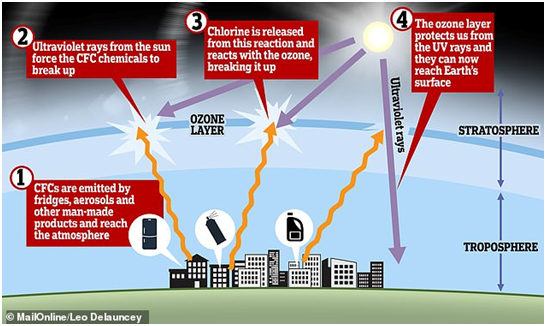
- Earth's ozone layer acts like a sunscreen, shielding the planet from potentially harmful ultraviolet (UV) radiation that can cause skin cancer, cataracts, suppress immune systems and damage wildlife. It is produced in tropical latitudes and distributed around the globe.
- The four-yearly review of the Montreal Protocol, a 1987 ban on man-made gases that damage the fragile high-altitude ozone layer, found long-term decreases in the atmospheric abundance of controlled ozone-depleting substances and the on-going recovery of stratospheric ozone.
- A hole was found in the ozone layer above Antarctica in the 1980s as a result of harmful chemicals being pumped into the atmosphere. This has allowed large amounts of ultraviolet light to reach Earth unabated and has been linked to an increase in skin cancer diagnoses.
- Scientists have now found that severe bans on the manufacture of these products have seen the hole in the ozone recover at a rate of one to three per cent per decade.
- The U.N. had already hailed the success of the Montreal Protocol, which banned or phased out ozone depleting chemicals, including chlorofluorocarbons (CFCs) once widely used in refrigerators and spray cans and were found to be the main reason behind the loss of the ozone layer, but the report said it was the first time that there were emerging indications that the Antarctic ozone hole had diminished in size and depth since 2000.Chlorofluorocarbons (CFCs)
- Chlorofluorocarbons are nontoxic, non-flammable chemicals containing atoms of carbon, chlorine, and fluorine. They are used in the manufacture of aerosol sprays, blowing agents for foams and packing materials, as solvents, and as refrigerants.
- CFCs are classified as halocarbons, a class of compounds that contain atoms of carbon and halogen atoms. Individual CFC molecules are labelled with a unique numbering system. For example, the CFC number of 11 indicates the number of atoms of carbon, hydrogen, fluorine, and chlorine.
- Whereas CFCs are safe to use in most applications and are inert in the lower atmosphere, they do undergo significant reaction in the upper atmosphere or stratosphere where they cause damage.
- The study also looked at the thinning of the ozone layer in the Arctic and found the annual variations were much larger. This made it harder for the researchers to confirm if there had been a definite recovery in the layer since 2000.
- However, while most of the banned gases have been phased out, the report found at least one violation of the protocol: an unexpected increase in production and emissions of CFC-11 from eastern Asia since 2012. The report said the source country or countries had not yet been identified.
- If CFC-11 emissions continued at the same rate, return of mid-latitude and polar ozone-depleting chemicals to their 1980 values would be delayed by about 7 and 20 years, respectively.
- The Antarctic ozone hole was expected to gradually close, returning to 1980 levels in the 2060s.

Significance
- The report said it was the first time the Antarctic ozone hole had shrunk in size and depth since 2000.
- At projected rates, Northern Hemisphere and mid-latitude ozone is scheduled to heal completely by the 2030s followed by the Southern Hemisphere in the 2050s and Polar Regions by 2060.
Subscribe to:
Posts (Atom)
Current Affairs December 07, 2018
It is celebrated on December 7 every year to spread awareness of civil aviation among the people of the international civil aviation day...
-
What is food? Ans. Food is the edible substance which are consumed by humans and other animals to absorb energy for various activities ...
-
We should encourage them to make educated guesses at what they read and help them initially to make sense of the language of the text and ...
-
How many 7-digit numbers are there in all? Solution: The largest 7-digit number = 9999999 The smallest 7-digit number = 1000000 Th...