Wednesday, October 10, 2018

RECOVERY OF THE OZONE LAYER

Context
  • A recent study by UN has confirmed that the ozone layer that shields life from cancer-causing solar rays is recovering at a rate of one to three percent per decade, reversing years of dangerous depletion caused by the release of harmful chemicals.
  • Ozone is a molecule comprised of three oxygen atoms that occurs naturally in small amounts.
About
  • Earth's ozone layer acts like a sunscreen, shielding the planet from potentially harmful ultraviolet (UV) radiation that can cause skin cancer, cataracts, suppress immune systems and damage wildlife. It is produced in tropical latitudes and distributed around the globe.
  • The four-yearly review of the Montreal Protocol, a 1987 ban on man-made gases that damage the fragile high-altitude ozone layer, found long-term decreases in the atmospheric abundance of controlled ozone-depleting substances and the on-going recovery of stratospheric ozone.
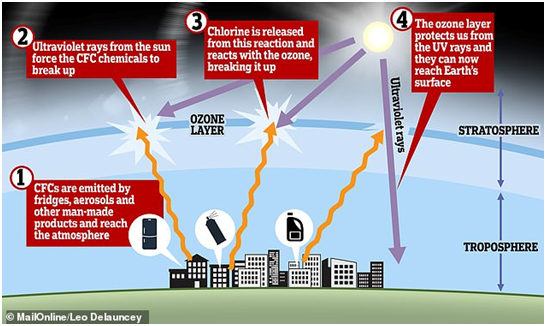
  • A hole was found in the ozone layer above Antarctica in the 1980s as a result of harmful chemicals being pumped into the atmosphere. This has allowed large amounts of ultraviolet light to reach Earth unabated and has been linked to an increase in skin cancer diagnoses.
  • Scientists have now found that severe bans on the manufacture of these products have seen the hole in the ozone recover at a rate of one to three per cent per decade.
  • The U.N. had already hailed the success of the Montreal Protocol, which banned or phased out ozone depleting chemicals, including chlorofluorocarbons (CFCs) once widely used in refrigerators and spray cans and were found to be the main reason behind the loss of the ozone layer, but the report said it was the first time that there were emerging indications that the Antarctic ozone hole had diminished in size and depth since 2000.

    Chlorofluorocarbons (CFCs)
    • Chlorofluorocarbons are nontoxic, non-flammable chemicals containing atoms of carbon, chlorine, and fluorine. They are used in the manufacture of aerosol sprays, blowing agents for foams and packing materials, as solvents, and as refrigerants.
    • CFCs are classified as halocarbons, a class of compounds that contain atoms of carbon and halogen atoms. Individual CFC molecules are labelled with a unique numbering system. For example, the CFC number of 11 indicates the number of atoms of carbon, hydrogen, fluorine, and chlorine.
    • Whereas CFCs are safe to use in most applications and are inert in the lower atmosphere, they do undergo significant reaction in the upper atmosphere or stratosphere where they cause damage.
  • The study also looked at the thinning of the ozone layer in the Arctic and found the annual variations were much larger. This made it harder for the researchers to confirm if there had been a definite recovery in the layer since 2000.
  • However, while most of the banned gases have been phased out, the report found at least one violation of the protocol: an unexpected increase in production and emissions of CFC-11 from eastern Asia since 2012. The report said the source country or countries had not yet been identified.
  • If CFC-11 emissions continued at the same rate, return of mid-latitude and polar ozone-depleting chemicals to their 1980 values would be delayed by about 7 and 20 years, respectively.
  • The Antarctic ozone hole was expected to gradually close, returning to 1980 levels in the 2060s.
Significance
  • The report said it was the first time the Antarctic ozone hole had shrunk in size and depth since 2000.
  • At projected rates, Northern Hemisphere and mid-latitude ozone is scheduled to heal completely by the 2030s followed by the Southern Hemisphere in the 2050s and Polar Regions by 2060.

Tuesday, October 9, 2018

ASK DISHA APP


Context
The Indian Railway Catering and Tourism Corporation (IRCTC), as first-of-its-kind initiative, recently launched AI chatbot-- Ask Disha (Digital Interaction to Seek Help Anytime) to help its users with various queries.
About
  • The chatbot is special computer programme designed to simulate conversation with users, especially over the internet.
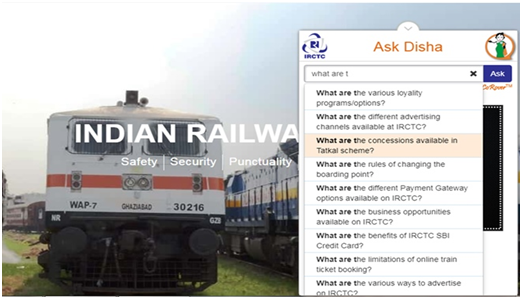
  • Users can ask questions to the AI chatbot by visiting the IRCTC website. As soon as the users start typing their queries, the AI chatbot automatically starts showing some options based on the typed phrases. Users can then either pick one of the queries from the displayed options or type in the complete question if their query is not being displayed on the screen.
  • The AskDisha is live now and will be voice enabled, supporting several regional languages.
  • The essential features of AskDisha include ability to quickly answer to customer queries, provide round-the-clock customer support, multitask, and zero waiting time for query to get answered.

  • It has been jointly developed by IRCTC and CoRover Private Limited, which is a Bengaluru-based startup that develops AI and machine learning based chatbots pertaining to travel and tourism.
Significance
With AskDisha, IRCTC becomes the first and only government corporation in India to launch a chat-enabled helpdesk service program.AskDisha chatbot will provide seamless service to website and Android app users. It willfacilitate accessibility by answering users' queries pertaining to various services offered by IRCTC. Thus, it will ensure that customers have a stress-free experience and provide overall satisfaction.

Monday, October 8, 2018

AFFORDABLE WATER DISINFECTION SYSTEM- ONEER


Context
An innovative technology for “Drinking Water Disinfection System” with trade name “Oneer” has been developed by Council of Scientific and Industrial Research, Indian Institute of Toxicology Research (CSIR-IITR), Lucknow.
About
  • The device will continuous treat water and eliminate all disease causing pathogens such as virus, bacteria, fungi, protozoa and cyst to provide safe drinking water to domestic and communities settings as per national and international standards prescribed for potable water (BIS, WHO etc.).
  • It will provide access to safe and clean drinking water at a cost of just 2 Paise / Ltr.
  • Its community level model has capacity of 450 LPH which can be scaled up to 5000 to 1 lakh L/day and is also maintenance and membrane free.
  • The smaller unit of Oneer is particularly suitable for homes, street food vendors, and small establishments.
CSIR-Indian Institute of Toxicology Research (CSIR-IITR), Lucknow, a constituent laboratory of the Council of Scientific and Industrial Research (CSIR), was established in 1965. It is the only institute of toxicology in the country contributing towards cutting-edge research and innovation in toxicology. It is working to mitigate problems of human health and environment.
It has following objectives:
  • Safety evaluation of chemicals used in industry, agriculture and everyday life.
  • Mode of action of toxic chemicals/pollutants.
  • Remedial/preventive measures to safeguard health and environment from pollutants.
  • Occupational health hazards due to exposure in chemicals industries, mines, agricultural fields and environment.
  • Simple/rapid diagnostic tests for disorders caused by industrial and environmental chemicals
  • Collect, store and disseminate information on toxic chemicals.
  • Human resource development for dealing with industrial and environmental problems.
  • Provide a platform to public and entrepreneurs to address queries and concerns regarding safety/toxicity of chemicals additives and products.
Significance
According to the World Health Organization, "access to safe drinking-water is essential to health, a basic human right and a component of effective policy for health protection”. But, currently, a large proportion of India's rural community is consuming water that does not meet the WHO drinking water quality standards. It is well known that infection through drinking water results in an increase in morbidity and mortality particularly amongst children. The developed technology will enhance the quality of life of common people. It will be helpful especially for rural people since it can be solar powered. At economy front, it is also in line with the ‘Make in India’ mission.

Sunday, October 7, 2018

DWARF PLANET 'THE GOBLIN' DISCOVERY

Context
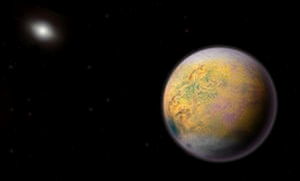
  • An extremely distant dwarf planet, named The Goblin, has been discovered in observations that are redefining the outer reaches of the solar system.
  • A new minor planet called “the Goblin” is the second most distant known object in the solar system.

About
  • Formal Name:As assigned by the International Astronomical Union’s Minor Planet Center, the new dwarf planetwould be formally known as 2015 TG387.
  • It is memorably nicknamed Goblin because its human examination occurred in roughly the Halloween time frame.Astronomers made the discovery while hunting for a hypothetical massive planet, known as Planet Nine.
  • The Goblin dwarf planet appears to be under the gravitational influence of a giant unseen object, possibly a hypothetical massive planet referred to as Planet Nine.
  • Telescope used:The Japanese Subaru 8-metre telescope located on the dormant Mauna Kea volcano in Hawaii was used.
  • Why this telescope? The telescope is the only one in the world to be able to produce deep images capable of probing the outer reaches of the solar system, while it also has a wide enough field of view to be able to cover enough sky to discover rare objects.
About Goblin:
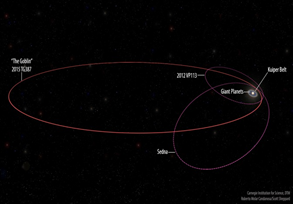
  • Radius: The newly discovered icy world, estimated to be just 300km across, is in an extremely elongated orbit. At its closest, it gets about two and a half times as far from the sun as Pluto.
  • Revolution time period: Then it heads off to the outermost fringes of the solar system, to almost 60 times further out than Pluto, taking an astounding 40,000 years to loop once around the sun.
  • For 99% of its orbit, it would be too faint to see.
Significance
Why it is important:
  • This will be adding to astronomers’ certainty that Planet Nine is out there.
  • The object is the third minor planet to have been found in the outer solar system, following the discoveries of Sedna and, recently, another object called 2012 VP113
  • Intriguingly the orbits of the three objects discovered so far appear to be clustered together, suggesting that they are being shepherded by a giant, unknown object. This has pointed astronomers to the existence of a ninth, super-Earth sized planet again.
  • Planet Nine is suspected to be in orbit far beyond Pluto in a mysterious region known as the Oort Cloud.

Saturday, October 6, 2018

CONSUMER CONFIDENCE SURVEY 2018: RBI


Context
Reserve Bank released the results of the September 2018 round of its Consumer Confidence Survey (CCS).
About
  • The survey seeks qualitative responses from households, regarding their sentiments on general economic conditions, overall price situation, employment, income, spending, scenario
  • Consumer confidenceis a key driver of economic growth and is widely considered a leading economic indicator of household spending on consumption. Confident consumers buy more goods and services, providing a boost to the Indian economy. Consumers tend to increase consumption when they feel confident about the current and future economic situation of the country and their own financial conditions.
  • The survey was conducted in some major cities.
  • The agency M/s Hansa Research Group Pvt. Ltd., Mumbai has been engaged to conduct the field work of this round of the survey on behalf of the Reserve Bank of India.
Findings
  • Economic Condition:Only 29.1% of those surveyed said their economic condition had improved from what it was a year ago, while 34.4% said it had worsened.Perceptions on the current general economic situation dropped as compared with the preceding round and remained in the pessimistic zone.
  • Price situation: While the majority of the respondents remained highly pessimistic about the price situation, there was a slight improvement in expectations one year ahead.
  • Employment:2% said their employment prospects had improved, while 45.5% said they had worsened. However, those surveyed are hopeful that job prospects will improve a year from now. The one-year-ahead-expectations survey shows there is a net positive response of 25.1 percentage points.
  • Income:On perceptions of income next the net response in September 2018, at 51.3 percentage points, is higher than 2013’s net response of 37.2 percentage points. People remain hopeful that incomes will rise; the government can derive some solace from that.
  • The survey portrays reduced optimism on spending by consumers, particularly in respect of non-essential items.
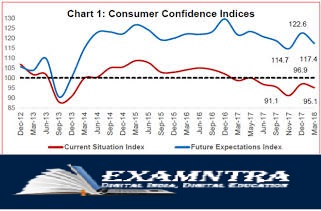
  • RBI’s current situation index of the consumer confidence survey is at 94.8 for September 2018, compared to 91.6 in December 2013, not too much of a gap, but, a marginal uptick is observed in the future expectations index at 121.1 points now, on the back of optimistic sentiments on future income, employment and the evolving price situation.
Significance
  • Barometer of governance: It reflects the measurement of how happy people are with the government’s management of the economy. The government has done a considerable job of keeping people’s hopes alive. The risk for the government is that current reality may finally dampen future expectations, which is what seems to be happening in the markets.
  • Boost to Indian Economy: In economies such as Indiaand the US, where personal consumption accounts for more than 60% and 70% of GDP respectively, consumer confidence has a particularly significant impact on the economy. Measuring it can provide critical insight into the economy's growth prospects. Consumer sentiment indices are essential tools used by global investors and will be an immense aid to individual and institutional investors in India.
  • Monetary policy formulation: The results of this survey will provide useful information, data and statistics for monetary policy formulation in accordance with the market expectations and push and pull factors.   

Friday, October 5, 2018

BILATERAL MARITIME EXERCISE BETWEEN JAPAN AND INDIA (JIMEX 18)


Context
Bilateral maritime exercise JIMEX-18 between India and Japan was held in Visakhapatnam.  
About
  • The nine-day event is aimed at enhancing inter-operability, improving understanding and imbibing the best practices of each other.
  • From Japanese side, Japanese Maritime Self Defence Force (JMSDF) with Ships Kaga, an Izumo Class Helicopter Destroyer and Inazuma – a Guided Missile Destroyer is taking part.
  • The IN was represented by three indigenously designed and built warships and a Fleet Tanker.
  • JIMEX-18 comprised of harbour phase and sea phase.
    • The Harbour Phase of the exercise will include professional and social interactions between ship’s crews, sports fixtures and operational planning for the Sea Phase.
    • The Sea Phase would include Anti-Submarine Warfare Exercises, VBSS (Visit, Board, Search and Seizure) Drills, Gun Firings, Cross Deck Helo Operations and coordinated operations in Anti-Submarine/ Anti-Air threat scenarios.
  • The last edition of JIMEX was conducted in Dec 2013 off Chennai.
  • Indo-Japanese Navies also participated in the recently concluded MALABAR 18 in the Pacific Ocean and biennial multilateral exercise RIMPAC-18 off Hawaii, USA.
  • In addition, the ships of the two navies have been working in close coordination in Anti-Piracy Operations in the Gulf of Aden for the past few years.
Significance

The conduct of JIMEX-18 after five years is indicative of an upswing in the Indo-Japanese defense relations and the continued efforts of both Governments to work closely to enhance safety and security of the global commons in keeping with ‘rule based order’.

Thursday, October 4, 2018

JEE Main Syllabus 2019


  • JEE Main 2019 Syllabus - Paper I
  • Mathematics
  • ·         Sets, relations and functions
  • ·         Complex numbers and quadratic equations
  • ·         Matrices and determinants
  • ·         Mathematical reasoning
  • ·         Mathematical induction
  • ·         Permutations and combinations
  • ·         Sequences and series
  • ·         Limit, continuity and differentiability
  • ·         Integral calculus
  • ·         Differential equations
  • ·         Binomial theorem and its simple applications
  • ·         Three-dimensional geometry
  • ·         Vector algebra
  • ·         Co-ordinate geometry
  • ·         Statistics and probability
  • ·         Trigonometry
  • Physics
  • Section A
  • ·         Physics and measurement
  • ·         Kinematics
  • ·         Thermodynamics
  • ·         Work, energy and power
  • ·         Rotational motion
  • ·         Gravitation
  • ·         Laws of motion
  • ·         Properties of solids and liquids
  • ·         Electronic devices
  • ·         Kinetic theory of gases
  • ·         Oscillations and waves
  • ·         Communication systems
  • ·         Current electricity
  • ·         Magnetic effects of current and magnetism
  • ·         Electromagnetic induction and alternating currents
  • ·         Electromagnetic waves
  • ·         Optics
  • ·         Dual nature of matter and radiation
  • ·         Electrostatics
  • ·         Atoms and nuclei
  • Section B
  • ·         Experimental Skills (complete syllabus in link below)
  • Chemistry
  • Physical Chemistry
  • ·         Some basic concepts in chemistry
  • ·         States of matter
  • ·         Atomic structure
  • ·         Chemical bonding and molecular structure
  • ·         Chemical thermodynamics
  • ·         Solutions
  • ·         Equilibrium
  • ·         Redox reactions and electrochemistry
  • ·         Chemical kinetics
  • ·         Surface chemistry
  • Organic Chemistry
  • ·         Purification and characterisation of organic compounds
  • ·         Hydrocarbons
  • ·         Chemistry in everyday life
  • ·         Principles related to practical chemistry
  • ·         Organic compounds containing halogens
  • ·         Organic compounds containing oxygen
  • ·         Organic compounds containing nitrogen
  • ·         Polymers
  • ·         Some basic principles of organic chemistry
  • ·         Biomolecules
  • Inorganic Chemistry
  • ·         Classification of elements and periodicity in properties
  • ·         Hydrogen
  • ·         Block elements (alkali and alkaline earth metals)
  • ·         P Block elements group 13 to group 18 elements
  • ·         d- and f - block elements
  • ·         Co-ordination compounds
  • ·         Environmental chemistry
  • ·         General principles and processes of isolation of metals
  •  

Current Affairs December 07, 2018

It is celebrated on December 7 every year to spread awareness of civil aviation among the people of the international civil aviation day...